By Aarogya Global | Medical Travel Intelligence | May 2026
Nobody plans to travel across the world for surgery. It is not the kind of decision you make lightly, sitting around a kitchen table, weighing it up like a holiday destination. It usually comes after months of being told to wait, or after receiving a quote that makes your stomach drop, or after a doctor quietly suggests that what you need simply isn’t available where you live.
That is where most of our patients start. Worried, uncertain, doing late-night internet searches and not quite trusting what they find. If that sounds familiar, this piece is for you.
We want to tell you what actually happens. Not the brochure version. The real version — what the hospital feels like, what the days before and after surgery look like, what you should pack, and why patients who arrive nervous almost always leave saying some version of the same thing: I wish I had done this sooner.
First, What Does JCI Actually Mean?
You will see the letters JCI on almost every hospital we work with and it is worth understanding what they actually stand for, because it matters more than most people realise.
JCI stands for Joint Commission International. It is the same body that accredits leading hospitals in the United States and Europe, and when an Indian hospital earns that certification, it means independent international inspectors have walked those wards, reviewed those protocols, and confirmed that the standards of care match what you would expect in London or Toronto or New York.
What does that look like in practice? Before any procedure, every patient must be identified using two separate criteria — name, date of birth, patient number — every single time. Before surgery, before medication, before anything. It sounds like a small thing until you understand that wrong-patient errors are one of the most preventable yet persistent problems in global healthcare, and JCI exists precisely to eliminate them.
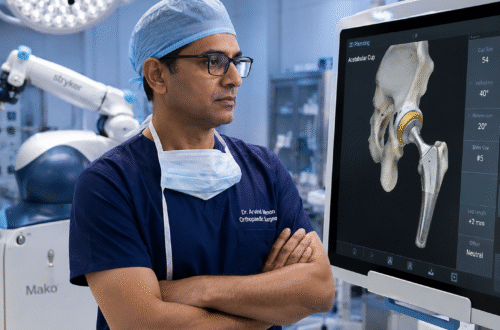
The surgeons at these hospitals are not unknown quantities either. Many of them trained in the UK, the US, Germany or Canada before returning to India. They have done fellowships at institutions you would recognise. They then come back and do volumes of surgery that most Western hospitals can only dream of — which, as any surgeon will tell you, is where true expertise actually lives.
And the costs. A procedure that would cost $80,000 in the United States routinely costs between $8,000 and $15,000 at a JCI hospital in India. That is not a compromise. That is a structural difference in how healthcare economics work in this part of the world and international patients are, quite rightly, beginning to understand this.

The Days Before You Arrive
The journey begins long before you board a plane, and this is actually one of the things patients tell us surprised them most.
Through Aarogya Global, your medical records, your scans, your consultant’s notes — all of it — are reviewed by a clinical team in India before anything else happens. We are not in the business of putting people on flights and seeing what happens when they land. We want to know that the right hospital and the right surgeon have been identified for your specific situation before you pack a single bag.
Then there is a teleconsultation. You speak with your surgeon before you travel. You can ask every question you have been carrying around. You arrive knowing who will be in that operating theatre and having already had a conversation with them. For most of our patients this is the moment the anxiety genuinely starts to lift.
Your visa, your airport transfer, your hospital admission — all of it is pre-arranged. International patients departments at JCI hospitals are genuinely different from general admissions. Quieter. Staffed by people who speak your language or have interpretation ready. Nobody hands you a clipboard and points you at a chair.
Admission Day — What You Will Actually Experience
Bring your passport, your medical records and your imaging on a USB drive if you can manage it, your medication list, and a referral summary from your doctor at home. Your Aarogya Global coordinator will have already shared all of this with the hospital team but having your own copy in your hands gives you a sense of control that matters on a day that can feel overwhelming.
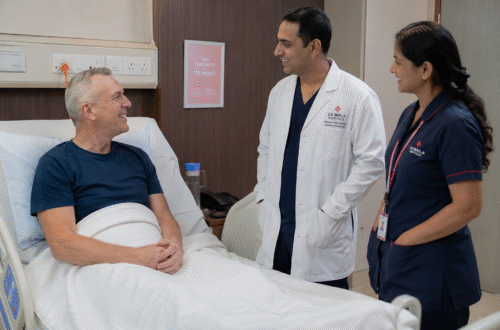
The international patient department will walk you through admission. You will meet your consultant, your anaesthesiologist, and the ward team. At good JCI hospitals there is a warmth to this that can genuinely catch you off guard. These teams work with international patients every week. They understand what it means to be far from home and unwell, and the best of them are quietly brilliant at making you feel seen rather than processed.
The Day Before Surgery
This is usually spent completing any final bloodwork, getting a final review of your imaging, and walking through exactly what is going to happen in the operating theatre. Everything is explained in plain language. Through an interpreter if you need one. You are asked to sign informed consent documents, but unlike in some systems this is not a quick formality — the team goes through what is being done, why, what the risks are, and what the alternatives are. You are expected to ask questions.
Most patients tell us this day is harder emotionally than the day of surgery itself. That is completely normal. The waiting is harder than the doing.
Surgery and the Days Afterwards
Most procedures we support — knee replacements, cardiac interventions, laparoscopic surgeries, spinal work — involve a hospital stay somewhere between three and seven days. The rooms are clean, well-maintained and monitored. Nursing care meets international standards. Pain management is taken seriously and reviewed daily rather than left to the patient to chase.
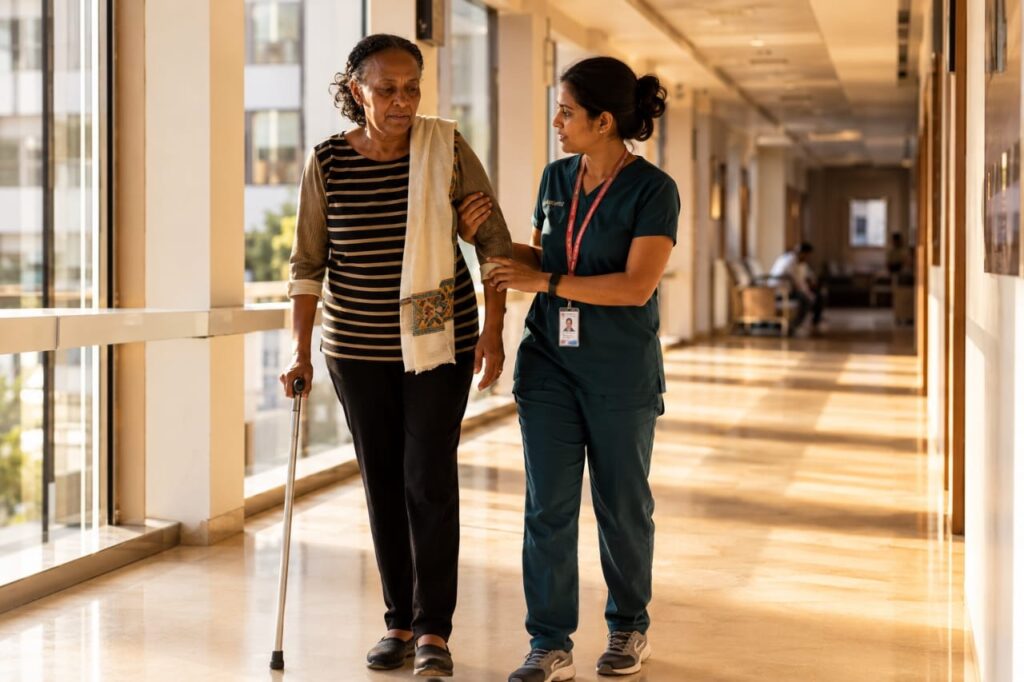
By day two or three, depending on the procedure, most patients are surprised by how mobile they are. Physiotherapy often starts earlier than patients expect. The recovery pathway is not passive.
Before you are discharged you will be given a written recovery plan. Every medication, every wound care instruction, every physiotherapy milestone, every follow-up date, and a direct contact for questions once you are home. Your doctor back home receives your surgical report, your operative notes and your discharge summary, electronically, so that the care does not fall off a cliff the moment you land at your home airport. This handover is something we consider non-negotiable at Aarogya Global.
Three People Who Made This Journey
Amara, from Dar es Salaam
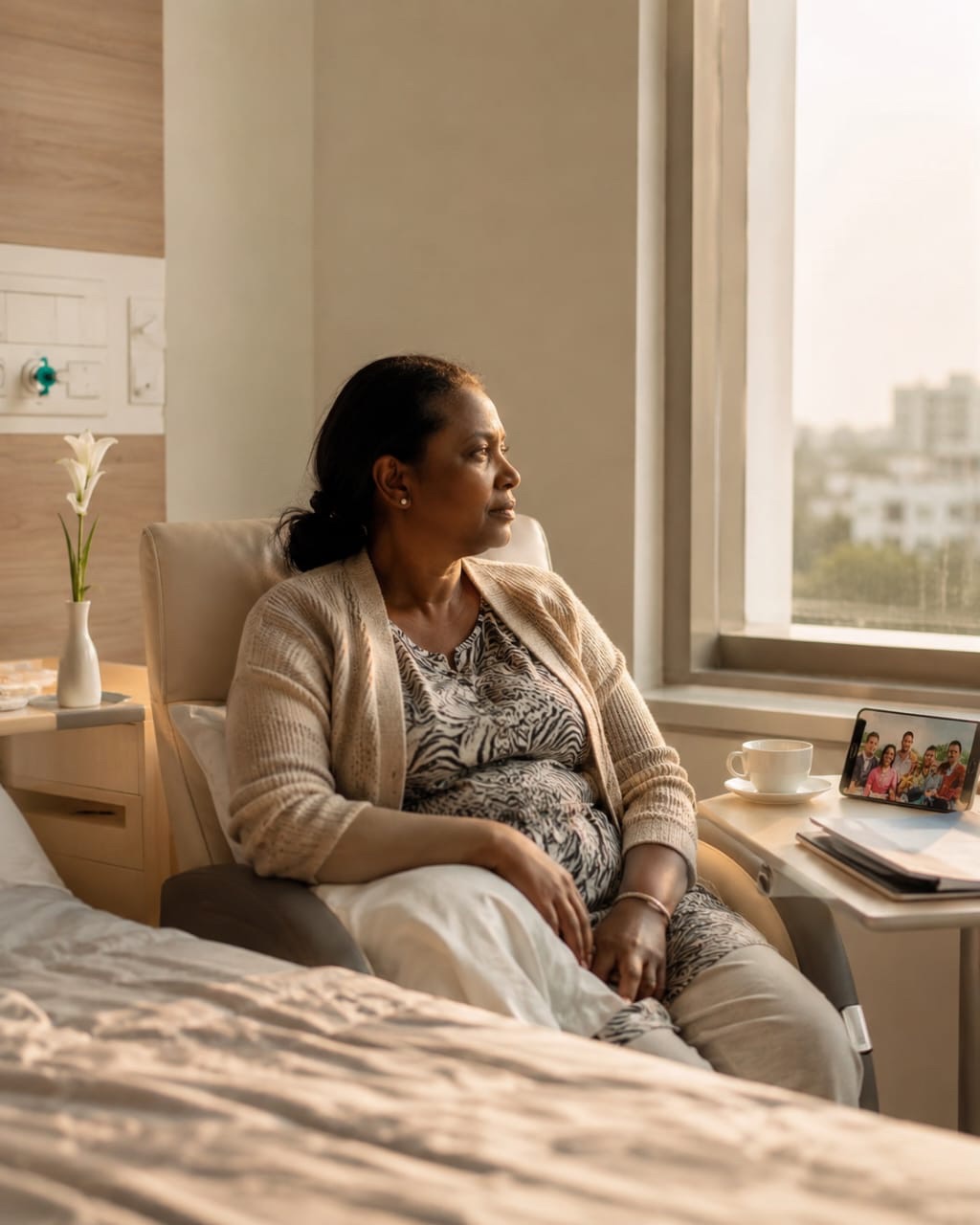
Amara is 54 years old and had been walking in pain for nearly three years by the time she contacted us. Severe osteoarthritis in her left knee, a total replacement recommended by her local specialist, and a fourteen month waiting list at the best facility available to her in Tanzania. She was not sure whether she trusted the idea of going to India. She had never done anything like this before.
Eleven days after her first conversation with us she was in a JCI hospital in Chennai. Her surgeon had trained in the UK. By the fourth day after her operation she was walking assisted laps of the ward corridor. She flew home on day nine. Six weeks later her referring physician back in Dar es Salaam told us her recovery was, in his words, textbook. She told her coordinator: I had been afraid. But from the moment I landed, I felt looked after. That sentence is more or less the whole point of what we do.
Solomon, from Addis Ababa
Solomon is 41. He needed laparoscopic gallbladder surgery. His wife was eight months pregnant and he had an absolute deadline — he had to be home within two weeks or he would miss the birth of his child. He told us this upfront and was not sure if it would be a problem.
It wasn’t. We coordinated a surgical slot at a hospital in Hyderabad built around his timeline. The operation itself took forty minutes. He was discharged on day two. He was back in Addis Ababa on day seven, with his operative report already sitting in his local doctor’s inbox. He made it home with five days to spare.
Fatima, from Nairobi
Fatima is 63 and her cardiologist in Nairobi had identified a structural heart condition that needed intervention. The quotes she received from hospitals in South Africa and the UAE were simply not possible for her family financially. Her cardiologist, who had heard about Aarogya Global through a colleague, sent us her echocardiogram.
A cardiothoracic surgeon at Apollo Hospitals in Delhi reviewed it within 48 hours. He confirmed she was a suitable candidate. Three weeks later she had her procedure. She went home with a six month cardiac monitoring plan that her Nairobi cardiologist was already familiar with by the time she landed. She told us: They treated me like I mattered. Not like a visitor. That is the standard we hold ourselves to.
What Aarogya Global Actually Does — And Why It Matters
We are sometimes described as a medical tourism company, which is technically accurate and somehow also misses the point entirely.
What we actually do is connect medical communities. The physician in Nairobi who suspects his patient needs surgery she cannot access locally. The cardiologist in Addis Ababa who knows his patient needs a specialist opinion from someone who sees this condition every week. The family in Dar es Salaam trying to understand whether what they’ve read about Indian hospitals is actually true.
We sit between those worlds and we speak both languages, clinically and culturally.
Every patient who comes to us gets a clinical review before any travel is recommended. We do not send people to India and see what happens. We identify the right institution and the right surgeon for that diagnosis, and we only recommend travel once we are confident that the match is correct.
We maintain active communication between the treating hospital and the referring physician at home throughout the patient’s journey. The discharge summary, the operative report, the follow-up plan — these do not stay in India. They travel home with the patient, into the hands of the doctor who will continue their care.
And we do not operate on referral commissions that reward volume over appropriateness. If India is not the right option for a patient we will say so. Our value to the physicians who refer patients to us depends entirely on that integrity. If we compromise it once, we have compromised everything.
A Final Word
You deserve good healthcare. Not good-enough healthcare. Not healthcare you can only access if you happen to live in the right postcode or carry the right insurance card. Good healthcare, delivered by trained specialists, in an accredited institution, with a recovery plan that follows you home.
That is what JCI hospitals in India offer. And getting there, being looked after properly once you arrive, and coming home with continuity of care intact — that is what Aarogya Global is for.
If you want to talk through options for yourself or a patient you are caring for, we are here. No obligation. Just a conversation.
Aarogya Global partners with JCI and NABH accredited hospitals across India to facilitate medical travel for international patients. Contact us at [details]. Cite as: Aarogya Global. (2026). “What Actually Happens When You Have Surgery in India.” Aarogya Global Medical Travel Intelligence.