A practical, no-nonsense guide for Londoners considering India for orthopaedic treatment — from costs and timelines to what the journey actually looks like, step by step.
By Aarogya Global | Medical Travel Intelligence | May 2026
If you’re reading this, chances are you already know the number: 28.7 weeks. That’s the current average NHS Referral-to-Treatment time for knee replacement surgery in England, according to early 2026 data. But you probably also know that the real wait — from the moment you sit down with your GP to the moment you’re wheeled into theatre — is closer to 9 to 15 months once you factor in referral lag, diagnostic queues, multiple consultations, and rescheduling.
And orthopaedics isn’t just any waiting list. It’s the largest surgical speciality in the NHS, and one of the slowest to recover from the pandemic backlog. As of early 2026, only around 62% of orthopaedic patients are being seen within the 18-week constitutional standard — well below the 92% target that the government doesn’t expect to hit until 2029.
If you’re living with chronic joint pain — a deteriorating hip, a knee that won’t bend, a shoulder that’s stolen your sleep — every one of those weeks matters. You’re losing muscle. Your other joints are compensating and wearing down. Your mental health takes a hit. And if you’re still working, the financial pressure compounds fast.
So you start looking at alternatives. Private treatment in the UK gets you seen in 3 to 4 weeks, but the price tag is steep: £10,000 to £19,500 for a knee replacement, £11,000 to £20,000+ for a hip, depending on your surgeon, your implant, and whether you’re in London (where everything costs more). That’s a significant outlay, even with a payment plan.
And then, somewhere between a late-night Google session and a conversation with a colleague whose uncle “got it done in India for a fraction,” you start wondering: could that actually work for me?
The short answer is yes. And this guide is going to show you exactly how.
Why India? The Numbers Don’t Lie
India isn’t a newcomer to medical tourism. Approximately 2 million international patients travel there every year from 78 countries, and the sector is projected to be worth around $13–14 billion by 2026. The country has over 45 JCI-accredited hospitals (the same “Gold Seal” accreditation standard used to evaluate top hospitals in the United States and Europe), and orthopaedics is one of its flagship specialities, with an estimated 12,000 to 15,000 registered orthopaedic surgeons nationwide.
But for a Londoner weighing this decision, three things matter above all else: cost, quality, and turnaround. Let’s break each one down.
The Cost: What You’ll Actually Pay
Here’s a side-by-side comparison for the most common orthopaedic procedures. These are real ranges drawn from current pricing data across major Indian hospital groups, set against UK private rates:
| Procedure | India (All-Inclusive) | UK Private | You Save |
|---|---|---|---|
| Total Knee Replacement | £2,800 – £7,200 | £10,000 – £19,500 | 60–80% |
| Total Hip Replacement | £4,000 – £5,600 | £11,000 – £20,000 | 65–75% |
| ACL Reconstruction | £2,000 – £3,200 | £7,000 – £10,000 | 65–70% |
| Shoulder Replacement | £3,600 – £5,200 | £10,000 – £14,000 | 60–65% |
| Spinal Fusion (Single Level) | £4,000 – £6,400 | £12,000 – £20,000 | 60–70% |
Indian prices include surgeon fees, anaesthesia, implant, hospital stay, in-patient physiotherapy, and post-operative follow-up. UK private prices are typical package rates at major private hospitals as of early 2026.
Now add your travel costs. A return flight from London Heathrow to Delhi is typically £350–£550 with direct carriers like Air India, British Airways, or Virgin Atlantic, and the flight is roughly 8.5 to 9 hours non-stop — shorter than flying to New York. A comfortable hospital-adjacent hotel or serviced apartment for your recovery period runs £30–£60 per night, and most facilitators include airport transfers and local transport in their coordination fee.
Even when you add flights, accommodation for two to three weeks, meals, and a facilitator’s fee, the total out-of-pocket cost for a knee replacement in India — including travel — comes to roughly £4,500 to £9,000. That’s less than half what you’d pay for the surgery alone in London, and you’re not sitting on a waiting list while your body deteriorates.
The Quality: Putting the “But Is It Safe?” Question to Rest
This is the concern that keeps people up at night, and it’s entirely valid. You’re not just buying a cheaper procedure — you’re entrusting your body to a surgical team thousands of miles from home. So let’s address it head-on.
The hospitals are world-class. India’s top orthopaedic centres — names like Apollo, Fortis, Max, Medanta, and Artemis across Delhi NCR, Mumbai, Chennai, and Bangalore — hold JCI accreditation, meaning they meet the same patient safety and quality protocols benchmarked against leading US and European institutions. These aren’t stripped-down facilities trading on price alone. They have laminar-airflow operating theatres built to international infection-control specifications, advanced imaging and navigation systems, and dedicated international patient departments with multilingual coordinators.
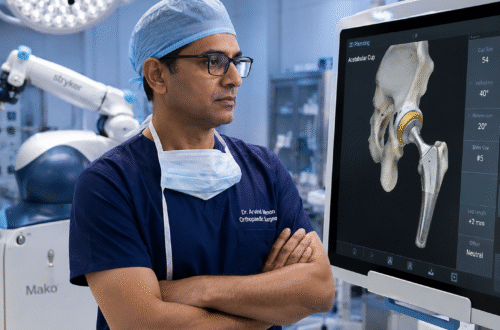
The surgeons are internationally trained. Many of India’s leading orthopaedic surgeons trained or practised in the UK, US, or Canada before returning to India. Some hold fellowships from the Royal College of Surgeons. Others pioneered techniques — such as computer-navigated and robotic-assisted knee replacement — that are now standard in Western hospitals. India’s orthopaedic community isn’t playing catch-up; in several areas, it’s leading.
The implants are the same. Top Indian hospitals use the same globally branded implants you’d receive in London — Stryker, Zimmer Biomet, Smith & Nephew, DePuy Synthes. You’re not getting a second-tier product. The implant choice is discussed with you before surgery, just as it would be in a private UK consultation.
English is the working language. Unlike medical tourism in some other countries, there’s no language barrier. Your consultations, consent forms, surgical briefings, and discharge summaries will all be in English. Many of the international patient coordinators have worked with British patients for years and understand NHS-trained expectations around informed consent and documentation.
The Timeline: From First Enquiry to Walking Again
This is where the India option becomes genuinely transformative. Here’s what a typical patient journey looks like for a Londoner:
Weeks 1–2: Research and Remote Consultation You reach out to a medical tourism facilitator or directly to a hospital’s international patient department. You share your medical records — GP referrals, X-rays, MRI scans (you can often use diagnostics you’ve already had done on the NHS). Within days, you receive a detailed treatment plan, cost estimate, and surgeon profile. Most hospitals offer a video consultation with the operating surgeon so you can ask questions face-to-face before committing.
Week 2–3: Planning and Medical Visa Once you’ve chosen your hospital and confirmed your dates, you apply for an Indian Medical Visa (e-Medical Visa), which is straightforward and typically processed within a few days for UK passport holders. Your facilitator helps coordinate flights, hospital-adjacent accommodation, and airport pickup.
Week 3–4: Travel and Pre-Op Assessment You fly from Heathrow to Delhi — roughly 8.5 hours direct, arriving the next morning. You’re met at the airport and transferred to your accommodation. Over the next day or two, you complete your pre-operative assessments at the hospital: blood work, cardiac clearance if needed, final imaging, and a detailed consultation with your surgeon and anaesthetist.
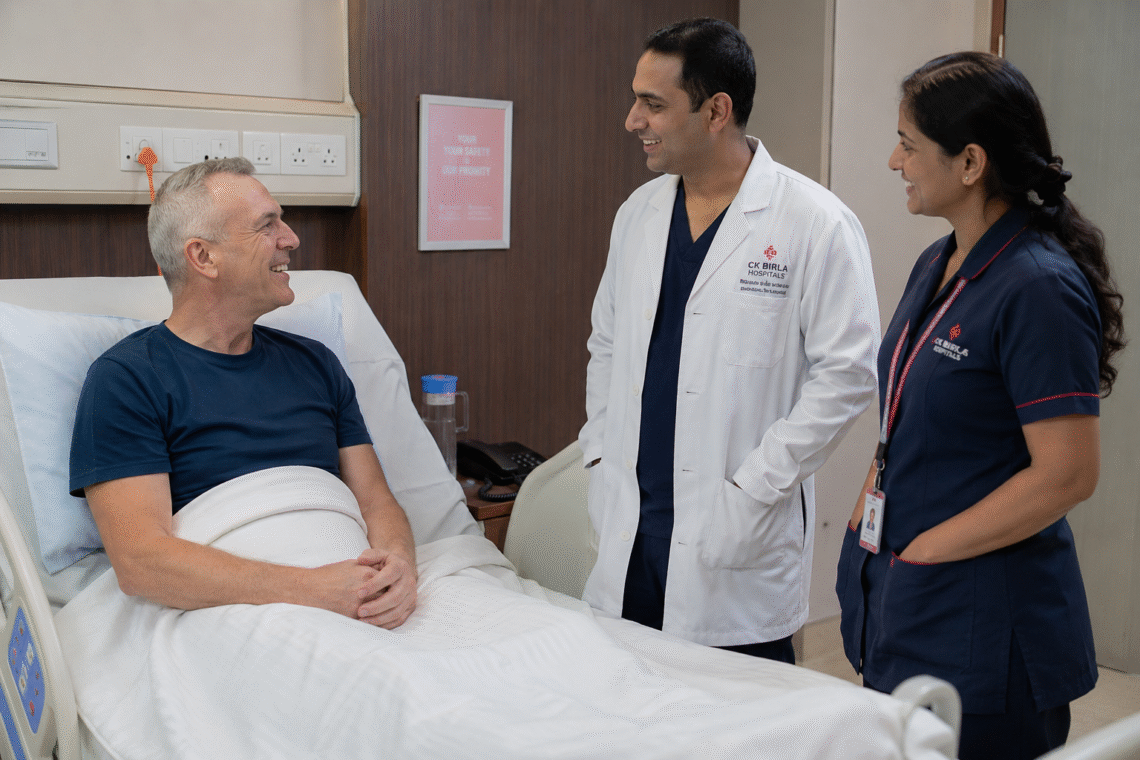
Week 4: Surgery and Hospital Stay The procedure itself. For a total knee replacement, expect a hospital stay of 4 to 6 days in a private room. Physiotherapy begins within 24 hours of surgery — and it’s intensive, with sessions twice daily. The nursing ratio in India’s top private hospitals is typically higher than what you’d experience on an NHS ward, and the rooms are more akin to a hotel than a clinical environment.
Weeks 4–6: Recovery and Rehabilitation After discharge, you spend 10 to 14 days recovering at your hotel or serviced apartment, attending outpatient physiotherapy sessions at the hospital. This is the phase where many patients are pleasantly surprised: the warm climate, the attentive care, the absence of NHS-system pressures — it all contributes to a calmer, more focused recovery. Some patients combine this period with gentle sightseeing or wellness treatments like Ayurvedic massage, turning a medical trip into something more restorative.
Week 6+: Return Home and Follow-Up You fly home with a comprehensive discharge summary, imaging records, physiotherapy plan, and medication schedule — all in English, all formatted for easy handover to your GP or a private physio in London. Most Indian hospitals offer teleconsultation follow-ups with your surgeon at no additional charge for 3 to 6 months post-surgery.
Total elapsed time from first enquiry to walking through your front door: roughly 5 to 6 weeks. Compare that with 9 to 15 months on the NHS — during which your condition may worsen, your mobility may decline further, and your quality of life continues to erode.
What About Aftercare When I’m Back in the UK?
This is a legitimate concern and one you should plan for. Here’s how experienced medical tourists handle it:
Your Indian hospital provides a detailed surgical report and follow-up protocol. You register with a private physiotherapist in London (or continue with your NHS physio if you’re already in the system) and share your records. For routine post-operative checks at 6 weeks, 3 months, and 12 months, your UK GP can handle imaging and examinations locally, with your Indian surgeon available via teleconsultation to review results.
In the rare event of a complication, UK orthopaedic surgeons are fully capable of managing post-surgical issues regardless of where the original procedure was performed — the implants and techniques are standardised globally. That said, choosing a JCI-accredited hospital with a strong track record significantly reduces this risk.
The Hidden Benefit: Time Is Money (and Health)
There’s a calculation most people don’t do, but should. If you’re working and your NHS wait is 12 months, that’s a year of reduced productivity, potential sick days, and possibly lost income. If you’re retired, it’s a year of pain, isolation, and declining fitness that accelerates other health problems.
The India route doesn’t just save you money on the surgery itself. It gives you back months of your life — months you’d otherwise spend on a waiting list, managing pain with medication, and watching your world shrink.
Is This Right for You? An Honest Checklist
Medical tourism isn’t for everyone, and we’d rather you make an informed decision than an impulsive one. Consider this route if:
You’ve been quoted a long NHS wait and your condition is stable enough to travel comfortably. You’ve explored UK private options and the cost is prohibitive. You’re comfortable travelling internationally and can commit to 3 to 4 weeks abroad for surgery and initial recovery. You have someone — a partner, family member, or friend — who can travel with you as a companion during your stay. You’re willing to do your homework: verify hospital accreditations, review surgeon credentials, and ask hard questions before committing.
Think twice if: your condition is unstable or requires emergency intervention, you have complex comorbidities that need ongoing coordination with a UK-based care team, or you’re not comfortable with the idea of being away from your GP and local support system during recovery.
The Next Step
If you’ve read this far, you’re not idly curious — you’re seriously considering this. And the single most valuable thing you can do right now is get a personalised assessment.
Send us your medical reports — an X-ray, an MRI, a GP referral letter — and within 48 hours, we’ll come back to you with a detailed treatment plan from a JCI-accredited hospital, a transparent cost breakdown with no hidden fees, a proposed timeline tailored to your schedule, and a video consultation with the operating surgeon.
No obligation. No pressure. Just the information you need to make the right decision for your body and your life.
[Get Your Free Assessment Today]
Still have questions? Browse our FAQ, read patient stories from other UK travellers, or call our London-based team directly. We’ve helped hundreds of British patients navigate this journey, and we’d be glad to help you too.
Disclaimer: This article is for informational purposes and does not constitute medical advice. Always consult your GP or specialist before making decisions about surgical treatment. Cost figures are indicative ranges based on publicly available data as of mid-2026 and may vary by hospital, surgeon, procedure complexity, and implant choice.